Mudjacking or polyjacking: which lift is right for a sunken Olathe slab?
Both lift a sunken slab back to grade through holes drilled in it. One uses a cement slurry, the other a polyurethane foam. The difference is weight, hole size, cure time, price, and how long the fix holds on clay.
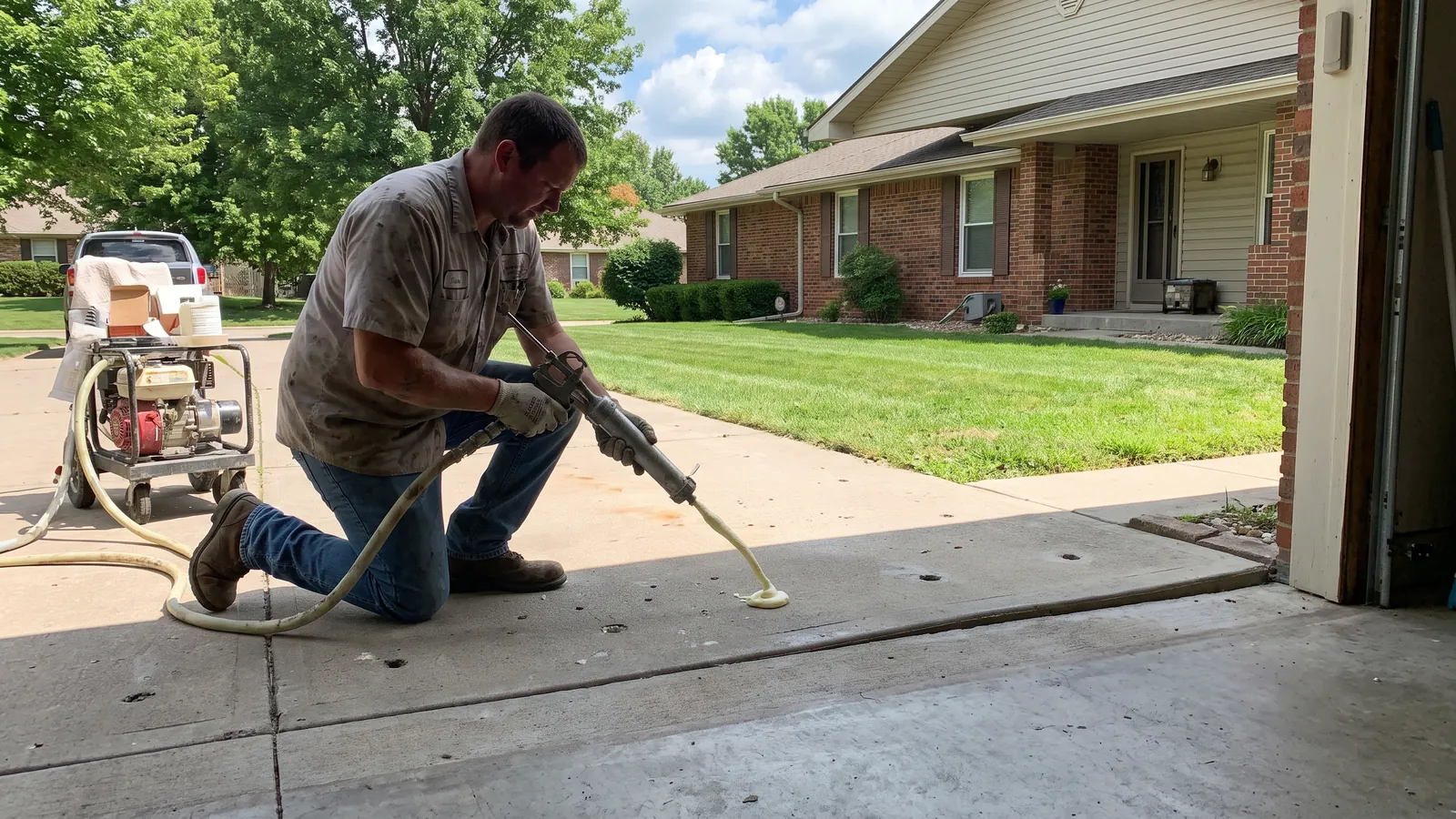
How each one works
Mudjacking (slabjacking) drills holes about an inch and a half to two inches across in the sunken slab and pumps a slurry of cement, soil and water underneath until the slab rises. It has been done since the 1930s. The slurry is heavy, about 100 pounds per cubic foot, it fills big voids cheaply, and it cures over a day or so.
Polyjacking (foam lifting) drills holes about five-eighths of an inch across and injects a two-part polyurethane that expands in seconds, fills the void and lifts the slab in a controlled way. The foam weighs two to four pounds per cubic foot, cures in about 15 minutes, doesn't wash out or shrink, and the holes are small enough to disappear once patched.
Side by side
| Mudjacking | Polyjacking | |
|---|---|---|
| Material | Cement, soil and water slurry | Expanding polyurethane foam |
| Hole size | About 1½–2 inches | About ⅝ inch |
| Weight added | About 100 lb per cubic foot | 2–4 lb per cubic foot |
| Cure / use | Next day for traffic | About 15 minutes; drive on it the same day |
| Fills small voids | Less well; slurry needs room to flow | Yes; foam travels into small gaps |
| Washes out | Can, if the water problem isn't fixed | No; closed-cell foam is waterproof |
| Typical driveway panel | $350 – $1,000 | $500 – $1,500 |
| Typical two-car driveway | $1,000 – $2,500 | $1,500 – $4,000 |
| Best for | Long runs of walk, big voids, tight budgets | Driveways, garage aprons, stoops, anything you drive on |
Which one we recommend, and why
For a driveway, a garage apron, a front stoop or a patio slab by the door, we usually recommend foam. It adds almost no weight to ground that already failed, it reaches into the small voids clay leaves behind when it shrinks, it won't wash out when the downspout floods the corner again, and the holes are nearly invisible. For a long run of public sidewalk on a tight budget, or a big void under a shed slab, mudjacking still makes sense and costs 30 to 40 percent less. Either way, the lift costs a fraction of replacement: $9,000 or more for a two-car driveway against $1,500 to $4,000 to lift it.
When neither is the answer
Lifting works on sound concrete that sank. It doesn't work on a slab broken into small pieces, a surface scaled to the stone, a panel heaved up by wet clay or a tree root, or a slab that has dropped so far the edges won't meet. Those get repaired or replaced, and we'll say so at the estimate rather than sell you a lift that won't hold.
Why slabs sink in Olathe
The clay. It shrinks in a dry summer and leaves a gap under the slab; the loose backfill along a foundation keeps settling for years; a downspout or a sprinkler head washes out the base at one corner. Lifting puts the slab back, but the water problem has to be fixed or it sinks again, which is why every lift we do comes with a note about the downspout. See clay and cracks.
Common questions
Is polyjacking worth the extra cost?
On anything you drive on or that touches the house, yes: it's lighter, it fills the small voids, it doesn't wash out and you use it the same day. On a long stretch of walk, mudjacking's lower price can win.
How long does a lift last?
As long as the ground stays put. Foam doesn't degrade; mudjacking slurry can wash out if water keeps getting under the slab. Fixing the downspout or the sprinkler is what makes either one permanent.
Will the holes show?
Foam holes are about the size of a dime and are patched with a color-matched mix; you have to look for them. Mudjacking holes are bigger and more visible.
Can you lift a public sidewalk?
Yes, with the City's right-of-way permit, since the sidewalk is City property.
Can a lifted slab crack?
If too much material is pumped in one spot, yes. Lifting in stages across several holes while watching a level is what prevents it.
Related: Mudjacking and polyjacking · Concrete repair · Driveway replacement · Clay and cracks